
Editora Active
A keyboard-driven, cross-platform programmer's editor with IDE capabilities that stay out of the way until you need them.
- Year
- 2025–
- Built with
- Java 25, JavaFX 26, RichTextFX, Maven
- Source
- github.com/adriandeleon/Editora
- Website
- editora-project.dev
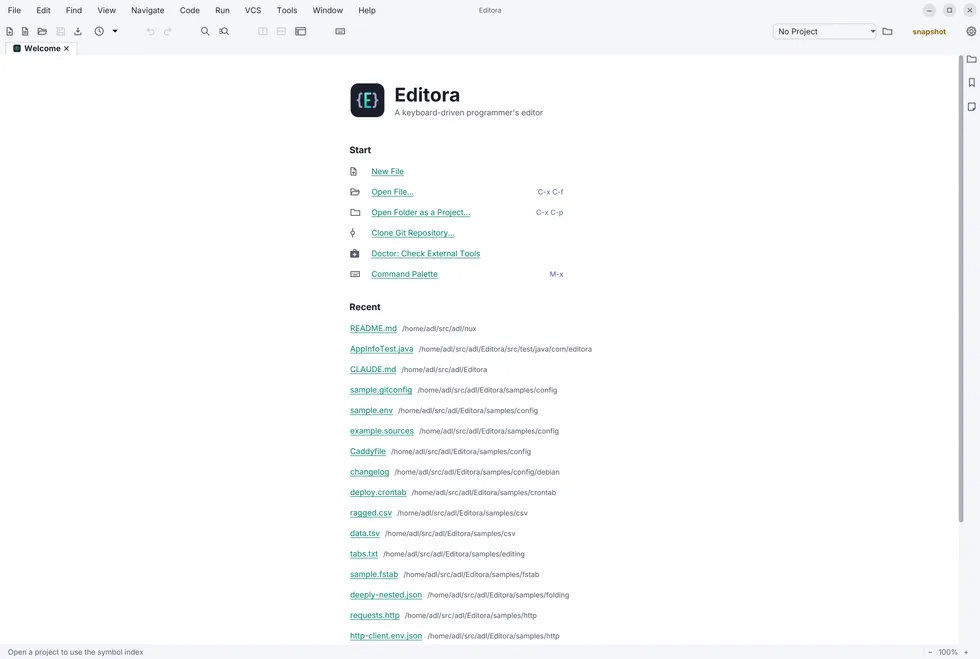
Editora is a keyboard-driven programmer’s editor built around a simple goal: IDE power at text-editor speed. It starts as a focused native editor, then brings in code intelligence, debugging, Git, previews, and other heavier tools only when the work calls for them.
One command system
Every action in Editora is a registered command. The menu bar, toolbar, keybindings, command palette, and plugins all dispatch through that same system, which keeps features consistent and discoverable.
Search Everywhere provides a single fuzzy interface for commands, project files, and symbols. Keymaps can follow Emacs, CUA, Sublime Text, VS Code, or IntelliJ conventions, and shortcuts—including multi-key chords—can be reassigned.
An editor that scales with the task
Four interface modes—Zen, Expert, Simple, and Full—let the workspace range from a distraction-free buffer to a complete development environment. The editor includes syntax highlighting across common languages and formats, multiple cursors, split editor groups, snippets, EditorConfig support, project navigation, and a dedicated log viewer.
IDE capabilities without bundling the world
Editora integrates with language servers for completion, diagnostics, navigation, refactoring, formatting, and code actions. When no language server is available, a built-in symbol scanner keeps navigation useful across many popular languages.
Run configurations, build-tool tasks, and debugger support sit alongside a native Git workflow with diffs, history, blame, stashes, and GitHub pull-request reviews. Remote projects can be opened over SSH and SFTP. External language servers, debuggers, and command-line tools are detected rather than bundled, keeping the core application lean.
More than source code
Editora previews Markdown—including LaTeX and Mermaid—along with HTML, Graphviz, PlantUML, structured data, and configuration files. Its plugin system can add commands, views, themes, languages, and integrations, while optional AI and agent-protocol support remains opt-in.