
Insula Active
A keyboard-first desktop reader for ZIM offline archives — Wikipedia and hundreds more, downloaded once and read forever with no network.
- Year
- 2026
- Built with
- Java 25, JavaFX 26, Maven
- Source
- github.com/adriandeleon/insula
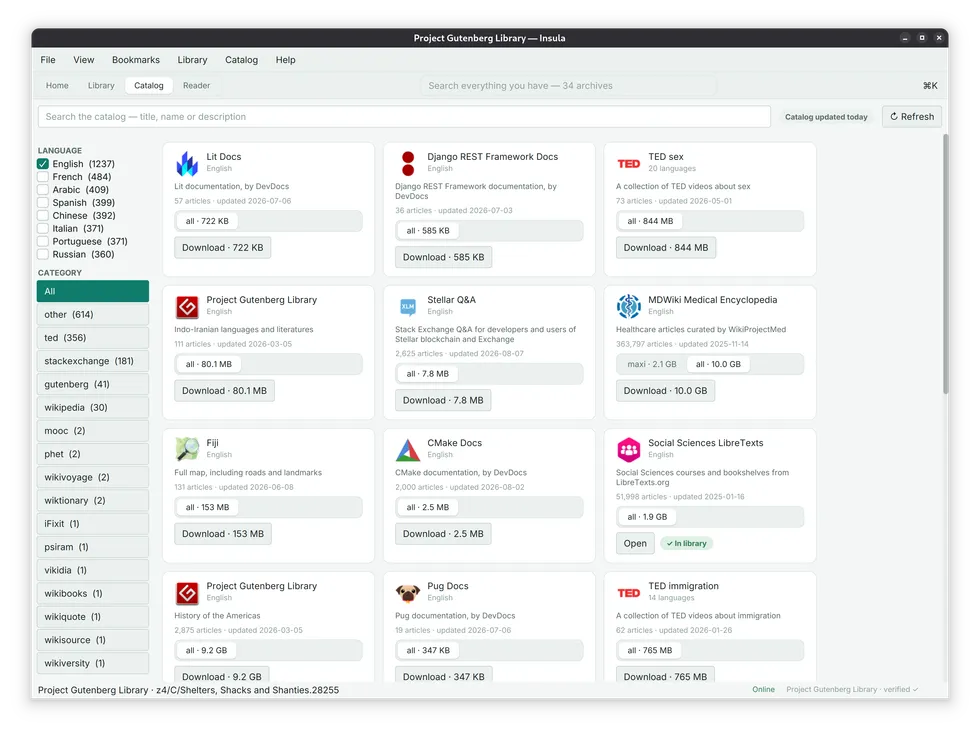
ZIM is the archive format behind Kiwix: a whole Wikipedia, Wiktionary, or StackExchange dump in a single file you can read entirely offline. Insula exists because the reading and library experience around those archives deserves better than it has — minimal chrome, instant search, everything reachable from the keyboard.
The ZIM reader is pure Java
No libzim, no JNI, no platform-specific native toolchain to install. There is
no maintained Java ZIM library to lean on — the one that existed is archived —
so the format core is written from the specification: the cluster compression
schemes (uncompressed, XZ, Zstandard) and both namespace generations, the
legacy A/I/M scheme and the current C/M/W/X.
Articles render with their images and stylesheets intact, because entries are served at their real archive paths over a loopback HTTP server. Nothing inside the archived HTML has to be rewritten to make links work.
Reading
- Cross-archive search — one box spanning every archive on disk, so you can look something up without first deciding which book it lives in. Results are ranked, tolerate a typo, and say which archive they came from.
- Reader mode whose dark theme wins against the archive’s own stylesheet, tables and inline colours included. Images are dimmed rather than inverted, so photographs and maps still look right.
- Reading position remembered per article, back/forward history, and a command palette listing every action with its shortcut.
Downloads that tell you the truth
Archives are tens of gigabytes, so the download layer is the other half of the project. It pulls from several mirrors at once over HTTP range requests and resumes after an interruption instead of starting over.
Integrity is the part worth stealing: the publisher’s Metalink file carries piece-level SHA-1 hashes, so every chunk is verified as it arrives, and the completed file against its published SHA-256. An archive is only offered for reading once it verifies — and one that fails is kept, not deleted, so a retry doesn’t mean re-downloading 100 GB.